Where Does Therapy End and Coaching Begin?

Updated: 3 hours ago
It can be a blurry line between healing the past and shaping the future — so how do you know what support you actually need right now?

DO I NEED THERAPY OR COACHING?
As a Coach who is married to a therapist, one of the questions I am asked frequently is what the difference is between coaching and therapy. It is a good question, for sure.
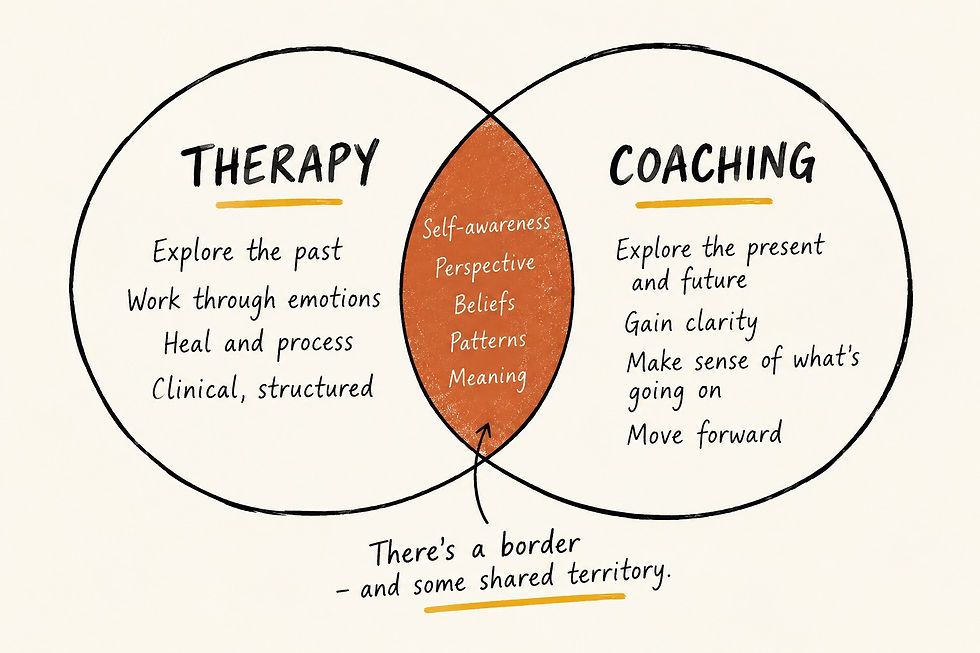
And to complicate things a little further, I practice depth coaching, so how does that differ from therapy? While many people enter the conversation with an initial leaning toward one method or the other, the reality in daily practice is that the boundary between coaching and therapy can feel downright blurry. So, which path should you take? While both modalities offer transformative personal support, they work with different tools, time-frames, and psychological orientations. Here is my take:
WHERE ARE YOU LOOKING? (PAST OR FUTURE)
For me, the most distinct difference lies in the time orientation. Therapy provides a spacious, meandering environment where insights can quietly surface in the days after a session. Therapy is willing to repeatedly revisit the past to explore personal history, resolve trauma, and understand unconscious patterns. It doesn’t hurry - it takes as long as it takes. Coaching, on the other hand, is more “pointy”. By which I mean it is distinctly present- and future-oriented. It is direct and goal-driven.
As a coach, I work in the gap between where you are right now and where you want to be. I aim to actively support and hold you accountable to your overall vision and “arc” with structured goals, action items, and clear momentum.
TIMEFRAMES, PACE AND FOCUS
Because therapy addresses foundational healing, it typically moves at an unhurried, spacious pace spanning months or years. Coaching operates on a much tighter clock —often our work together is compressed into a structured series of six to twelve sessions. The quicker cadence of coaching creates a different energy for both client and practitioner. For me as a coach, working within a compressed timeframe demands greater decisiveness and an intuitive focus on establishing your true priorities early on in our relationship so as to generate the right direction for us to explore. I find getting this right early on is key help you marshal your thoughts and generate the motivation you’ll need to pursue the emerging goals and milestones we set as we work together.
HOW DEEP TO GO: EXPLORING WHAT LIES BENEATH PROFESSIONAL BEHAVIOUR
There is a common myth that coaching is merely surface-level goal setting while therapy handles the “deep stuff.” However, in Psychosynthesis coaching, we work at the level of “being,” purpose, and self-realisation - all potent topics to explore.
For the senior leaders and professionals I work with, coaching is often the one place (perhaps the only place) where they can unpack what lies beneath outward behaviour—their history, personal beliefs, and existential questions—without this process being reduced to a tick box exercise.
We explore together how your inner world shapes how you show up in your workplace and jointly envisage and plan for the future, so that it plays out in line with your vision.

SAFETY BOUNDARIES: KNOWING WHAT'S "ABOVE MY PAY GRADE"
Working ethically at depth is fundamentally about trust on the one hand and knowing boundaries on the other. While coaching explores your backstory at depth, it is key that if something traumatic surfaces during a coaching session, I would immediately flag to you that what material is “above my pay grade”.
Being equipped for trauma is not just about personal depth—it requires specialised techniques and tools to safely hold that weight. Its the job of therapy to do that. In those moments, I will recommend a therapist that I know and trust to support that foundational healing, while our coaching remains focused on harnessing your potential to move forward.
HOLDING BOTH IN CREATIVE POLARITY
Rather than treating coaching and therapy as a rigid binary or letting them merge into a “muddy middle,” I feel its right to see them both existing on a spectrum of support. I work hard to make sure we squeeze all the juice out of our coaching work together, whilst recognising that sometimes therapy support is needed.
In reality, both coaching and therapy serve vital, complementary roles across different seasons of life. We all change as we age and accumulate experiences, wisdom and insights. I want to see healthy personal growth in my clients and this relies on engaging deeply with whichever process meets your current needs without losing sight of what each does best.

Comments