Midlife Career Change: One Step at a Time
Why the adjacent possible beats the ten-year plan, at work and at home.
You are in your mid or perhaps late forties and, on paper, everything works. Your title is right, the money is fine and funds your life, people rely on you. Nothing is broken and yet things have slowly gone flat. It’s not a crisis, not quite burnout, it’s just a question keeps surfacing that you keep pushing away: is this it?
Most people answer that question in one of two ways. They either push the question down by trying to numb themselves, perhaps dive into distractions outside of work, or they blow everything up. Yet there is a quieter, less dramatic and ultimately better third way: find some space to think and take small, deliberate steps into new territory.
THOSE FEELINGS HAVE A NAME FEELING FLAT ISN'T A SIGN OF DYSFUNCTION, RAHTER IT'S A KINF OF INFORMATION.
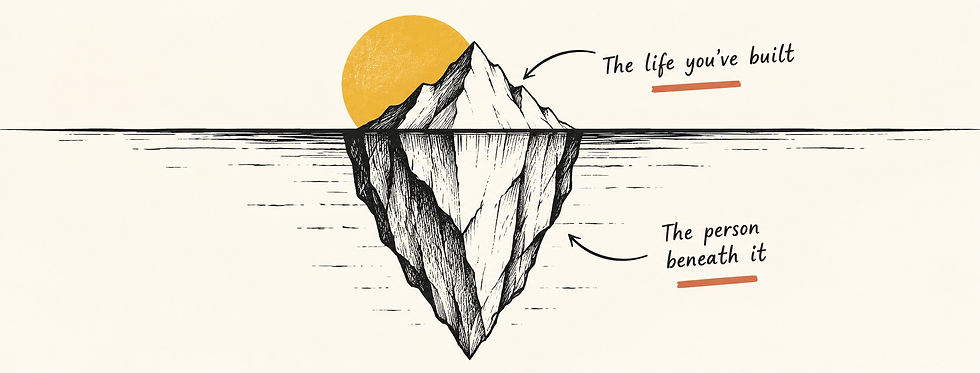
If you feel flat, this does not mean that you need to quit your job tomorrow. Rather, it tells you that something inside you has stopped being fed: so that feeling is highlighting questions of meaning, not performance. Your career has been spent building a work identity which has been marked by your unique combination of status, skills, experience and reputation. In your forties or indeed fifties, that identity can start to feel too small, and the other parts of you that were sidelined as you focused on the early career climbing, they re-emerge and ask to be included in your present.
WHAT THE ADJACENT POSSIBLE IS
The adjacent possible concept comes from the biologist Stuart Kauffman (Investigations, 2000). He argues that at any moment, only things that are one step away from what already exists for us are within reach - and that each step we do take changes what is reachable next. Steven Johnson popularised this further in Where Good Ideas Come From (2010).
Applied to your life, your anchor is really everything you have now: skills, contacts, reputation, relationships and self-knowledge. Your adjacent possible is the roles, projects, side gigs, and ways of living that are just the one step from your current anchor. So, if you take one step, your view changes. You do not need an ultimate destination fully mapped out, you only need to take the next step, and the good news is that by your late forties this ring of potential steps is far wider than it was at thirty.

ADJACENT POSSIBLE MOVES MAKE SENSE IN THESE TURBULENT TIMES
The ground underneath senior people in organisations has really changed fundamentally in the last few years. We all know the economic, social and political instability of the recent period and this is being worsened by environmental challenges and of course technological change. In a September 2026 survey of 350 UK senior leaders, the training firm Emergn found 38% fear their careers will suffer unless they improve their AI skills within a year. In June 2026 the Chartered Management Institute found only 12% of 1,000 UK managers felt very confident managing teams that use AI.
When the long term forecast keeps changing, a ten-year plan is really a well configured, high definition guess - perhaps even a comforting fiction. The clear take out is that going after small steps that you can test, and potentially undo, can make way more sense than going after one big, dramatic bet and life or career pivot.
THE GOOD NEWS ABOUT MIDLIFE CAREER CHANGE
The evidence is that most people who try to change direction mid-career manage it successfully. The American Institute for Economic Research surveyed 2,009 people aged 47 and over and found 82% of those who attempted a career change after 45 succeeded. Interestingly, the successful ones mostly moved into new work using skills they already had. In contrast, the unsuccessful ones tended to chase dramatic career pivots which needed them to acquire new skills. So, the implication is clearly that if its adjacent, it’s possible.
Herminia Ibarra, now at London Business School, followed professionals and managers through career change for her book Working Identity. She found that mid-career changers rarely thought, strategised or planned their way to the right answer. Rather, they found their way by experimenting with side projects, making new networks and creating possible new versions of themselves while keeping the day job going.
And, counter-intuitively, it seems that the network contacts you know less well may open more doors than contacts and people you know very well. For instance, a 2022 study of 20 million LinkedIn users found acquaintances led to more job moves than close friends. That’s worth bearing in mind.
YOUR PERSONAL LIFE ECHOES THESE DYNAMICS
Life outside work also shifts in midlife just as often as careers do. Drivers of change include children leaving home, parents needing care, a partner retiring, a relationship ending or perhaps feeling an inner pull to leave the city.
As with the career, its wise to take space to think - don’t automatically reach to make a dramatic, irreversible change. Rather, test things first, get feedback, review and then test again. So, if you are thinking of moving to the country or the coast, how about renting there for a month out of season before you sell up? If a partner is now newly at home all day, perhaps agree one shared goal or commitment for three months, then review how it’s gone? If you find yourself caring for an elderly parent then perhaps change one thing about your current weeks arrangement to accommodate this new responsibility, before you reorganise your whole life around caring.

SOME SPACE TO THINK
Four things matter in any transition. First and most importantly is to find somewhere to think before you do anything irreversible. If you find yourself in a flat patch then that is an invitation to slow down, not to resign after an especially bad Monday in the office.
Second, get some help to try and notice who inside you is doing the talking. Roberto Assagioli, who founded psychosynthesis, saw our personalities as made of distinct parts. In a long career one of them, which we could call the ‘Achiever’, the ‘Provider’ or perhaps the ‘Safe Pair of Hands’, runs the show, and those feelings of disquiet or flatness is often a quieter part of you asking for a turn.
Third, I have found that capable senior leaders often skip straight to planning. In Psychosynthesis coaching we put fleshing out purpose first, then deliberation, choice and commitment, before we look at anything about how we execute.
Lastly, turn your thinking into small tests or moves and then review what each of these has taught you, so your list of next steps is fresh and keeps updating. This is a territory where the support of a coach can be very helpful.
Published 23rd October 2026

Comments